Diagnostic intelligence · production agentic workflows

Catch what your agents get wrong — before your users do.

Wrap any LLM or agent client. Papaya reads the prompts, tools, and context around every call — and flags the regressions and quiet drift before they reach your customers.

  • One line wraps any LLM or agent client.
  • Async — no request-path latency.
  • You stay in control — human-in-the-loop on every change.

How agents really fail

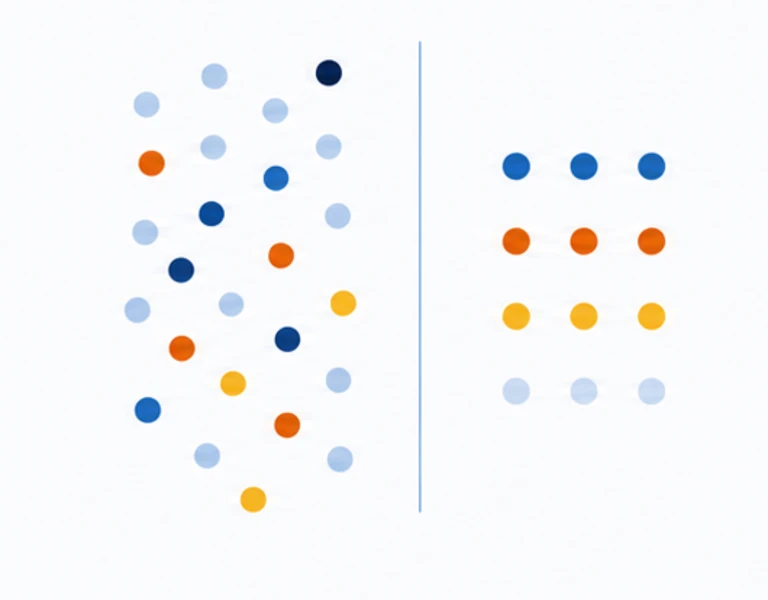
Most agent failures don't crash. They quietly disappoint.

Customers rarely email. They drop off mid-conversation, thumbs-down once, and stop using the feature. By the time you find out, the regression is two weeks old.

What you typically see

  • Tokens, latency, and cost on the model call
  • Top-line success rate
  • Errors when the call hard-fails
  • — and a customer email two weeks later.

What Papaya surfaces

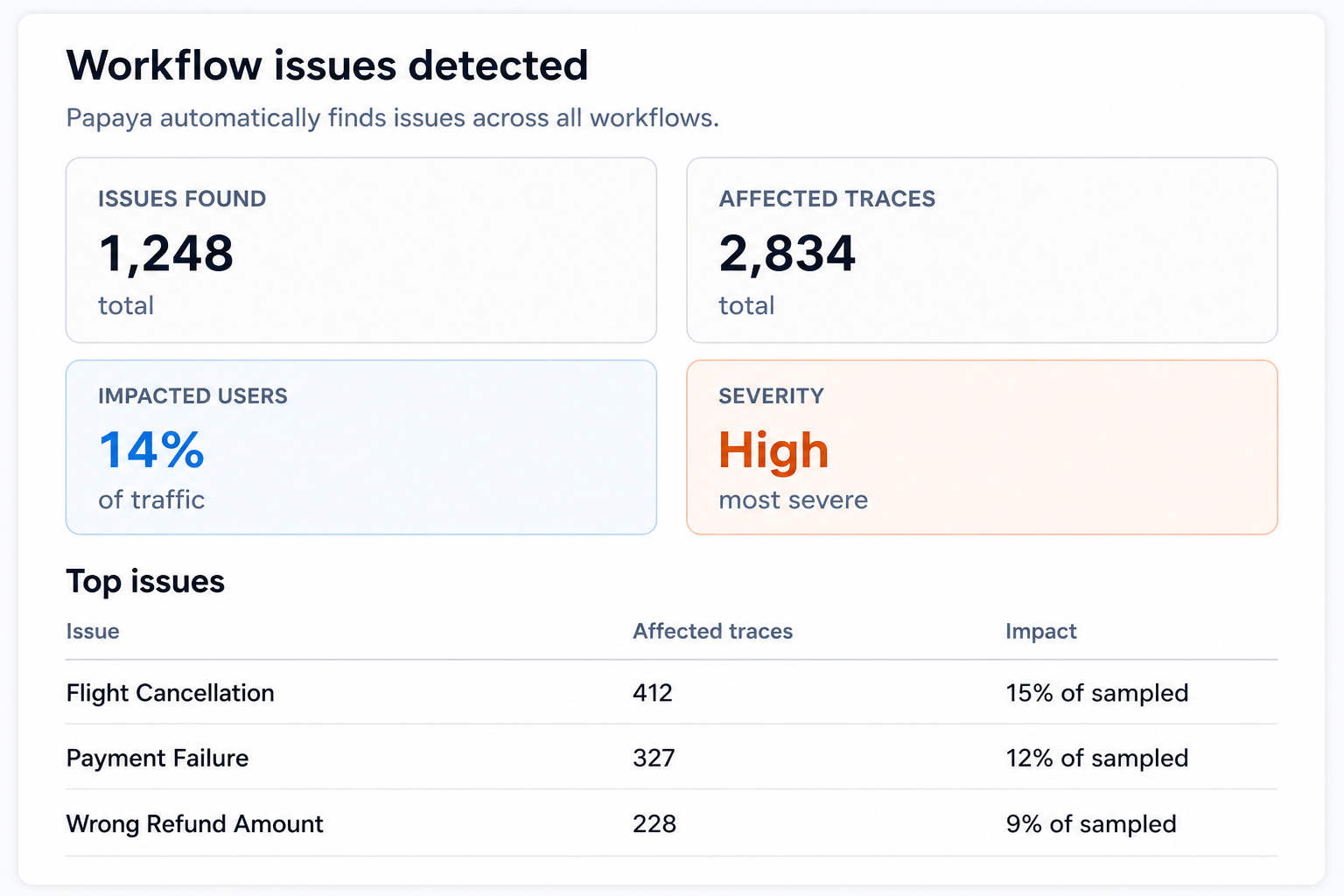
  • Where users drop off — and the run that produced it
  • Every thumbs-down, Slack reply, and email tied to its run
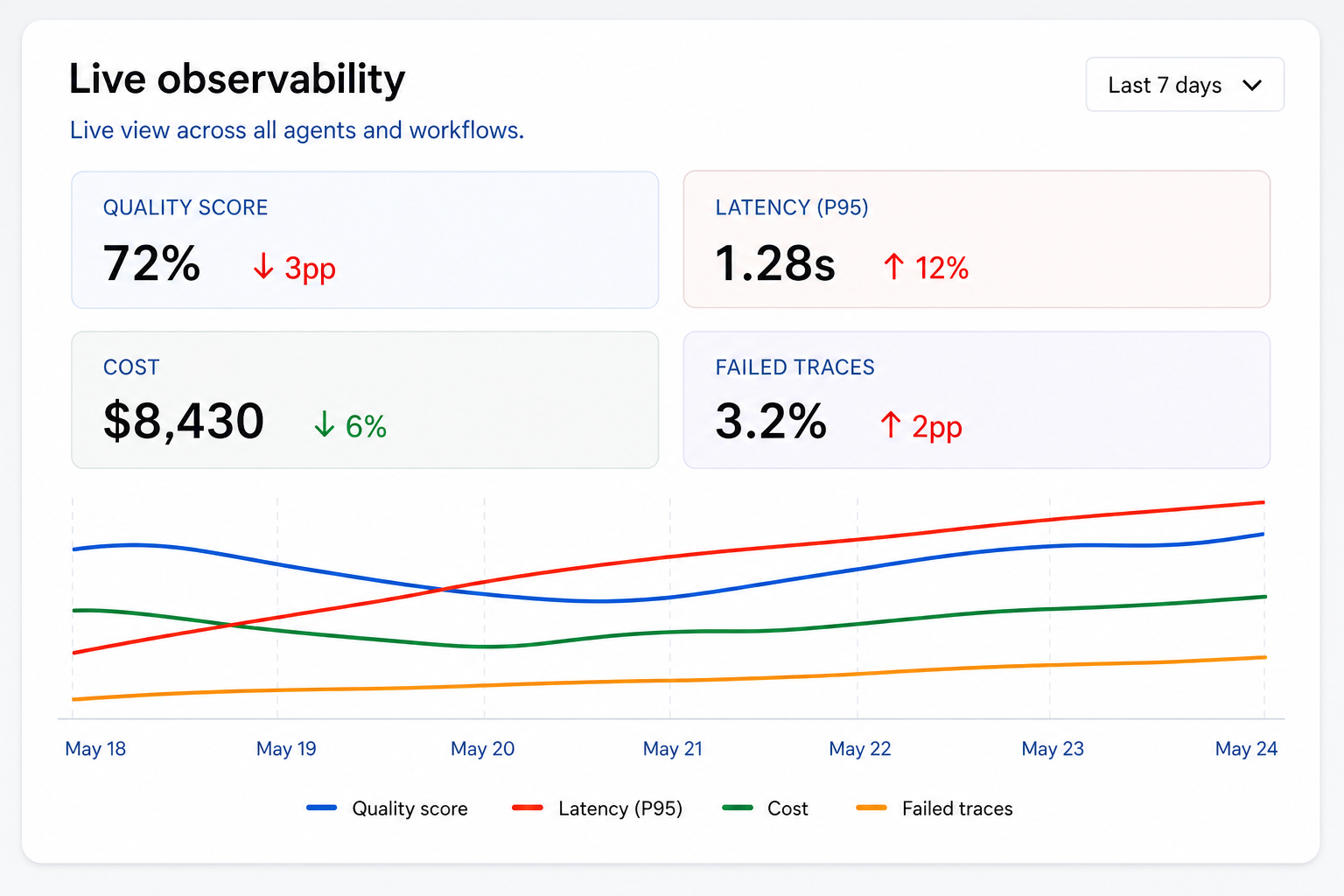
  • Live alerts when quality metrics drift, before customers escalate
  • Where retries, clarifications, or sub-agents silently loop
  • Which prompts, tools, and fields the model actually relied on
  • Where a smaller, cheaper model would be just as good

How it works

Wrap. Analyze. Review.

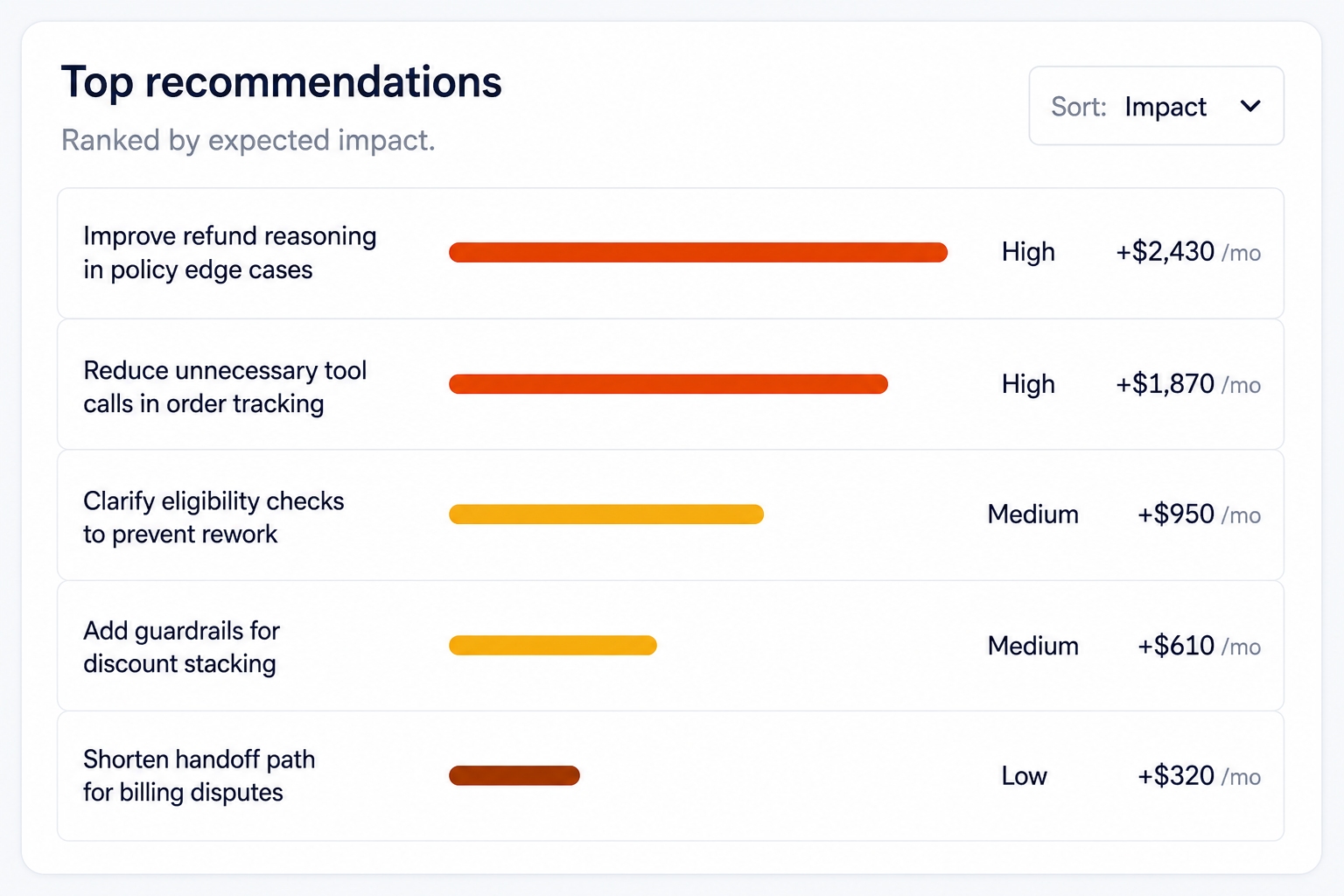
One line around any client. Engines analyze runs offline and cluster findings by root cause. You review ranked, evidence-backed opportunities and ship the fix.

01

Wrap your client

import { wrap } from "@papaya/sdk"

const client = wrap(openai, {
  workspace: "prod"
})

OpenAI, Anthropic, Bedrock, LangChain, LangGraph, hand-rolled clients. Or skip the SDK and pull from your existing Langfuse, Braintrust, or Helicone traces.

02

Diagnostic engines analyze

context economytool-call qualityverification designretry pathologyplan-and-execute shapeprompt-program structure

Engines built on current agent and LLM research read the runs end-to-end and cluster findings by root cause — not by surface symptom.

03

Review with evidence

  • The exact run that produced the finding
  • The prompt, tools, and context as the model saw them
  • Estimated impact, risk, and confidence

You verify before you decide. You stay in control of what ships and when.

Coverage

Six surfaces. Read end-to-end. Every run.

Most observability stops at the model call. Papaya reads everything the call depends on.

L1

Prompts

System, user, and tool prompts read end-to-end across runs.

  • Static preamble repeated every call
  • Instructions that contradict the tool schema
  • Context the model never references
L2

Scaffolding

The orchestration around the model — control flow, retries, gates.

  • Retry loops triggered by prompt design
  • Verification gates that never reject
  • Steps with no observable purpose
L3

Agent shape

How responsibilities are split across agents and sub-agents.

  • Sub-agents redoing the parent's work
  • Hand-offs that drop critical context
  • Roles that overlap without resolving conflicts
L4

Workflow structure

How steps compose across a complete user-facing task.

  • Clarifications stalling real work
  • Phases that could be combined or skipped
  • Successful patterns worth promoting to templates
L5

Tool usage

Which tools earn their keep — and which mislead the model.

  • Tools with unstable, run-to-run output
  • Calls that could be combined or cached
  • Outputs the next step never reads
L6

Context & data

What the model is actually looking at when it decides.

  • Critical fields missing from context
  • Bloat that drowns the relevant signal
  • Stale or duplicated data passed step-to-step

Anatomy of a finding

Every recommendation wired to the run that produced it.

Open any finding. See the prompt, tool output, and context the model actually saw. No leap of faith.

  • Traceable — each finding links to the runs you can replay.
  • Quantified — estimated impact, risk, and confidence on every card.
  • Actionable — the change is specific enough to ship.
Finding · L5 Tool usageHigh confidence

Retrieval tool returns 12k tokens. The next step reads about 800.

Sent to next step
12,400 tok
Actually read
820 tok
Workflow
customer-invoice-triage
Runs analyzed
1,840
Estimated savings
$2,140 / month
Quality risk
Low

Evidence chain

  1. Run #48-a2c1 · retrieval step → answer step
  2. Tool output: 12,400 tokens of policy text
  3. Answer step references 4 fields, totaling ~820 tokens
  4. 11 other runs show the same pattern
Recommended change

Filter retrieval to fields the answer step references. Cap output at 1,500 tokens.

Lifecycle

From wrap to gated rollout — one loop.

Findings, A/B tests, gated rollouts, and impact tracking share the same evidence. Diagnose, ship, and measure in one place.

  1. Wrap

    One line around your client.

    OpenAI, Anthropic, Bedrock, LangChain, or custom. Python, TS, Go. Nothing leaves your infra unless you say so.

  2. Analyze

    Async, off the request path.

    Runs grouped into workflows. Diagnostic engines cluster findings by root cause — not surface symptom.

  3. Review

    Ranked, evidence-backed.

    Each finding opens with the exact run, prompt, tools, and context the model saw. Verify before you decide.

  4. Test

    A/B test safely.

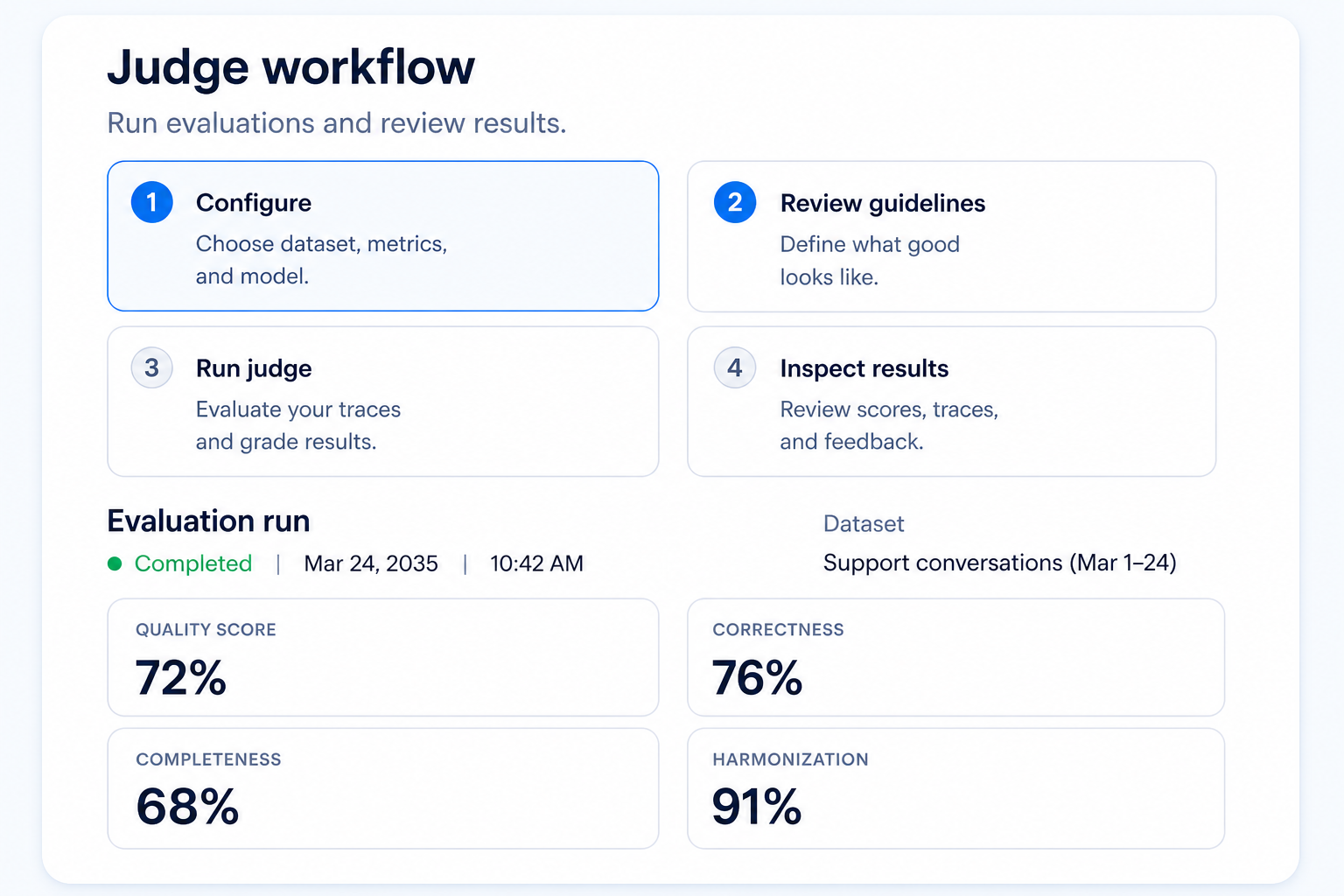
    Replay the fix on past traffic. Then split a slice of live traffic. Compare cost, latency, and quality side-by-side.

  5. Gate

    Slow-release on real impact.

    Promote by percentage, workflow, or segment. Auto-hold or roll back if measured impact diverges from prediction.

  6. Measure

    Close the loop.

    Every shipped change feeds back into the same evidence chain. The next finding is sharper than the last.

Diagnostic engines

The latest agent research, baked in.

Each engine encodes a body of agent research and applies it to your runs. New papers become new findings — automatically.

  • Context economy

    Detect what the model reads vs. what it's sent — informed by recent context-distillation research.

  • Tool-call quality

    Score tools on consistency, signal-to-noise, and whether their output changes the model's behavior.

  • Verification design

    Check whether self-checks actually catch failures the run produced — not just whether they run.

  • Plan-and-execute shape

    Identify reasoning that should be staged, parallelized, or collapsed based on observed run traces.

  • Retry pathology

    Cluster retries by root cause: parsing, tool flakiness, or instruction conflicts.

  • Prompt-program structure

    Surface scaffolding patterns that consistently outperform on similar workloads.

How it operates

200+ engines. Run continuously. Tracked through ship.

Engines analyze your sampled traffic around the clock. Findings cluster by root cause across thousands of runs, tie back to user behavior, alert you on drift, and track all the way through to measured impact.

01

Population, not trace

Findings cluster across thousands of sampled runs by root cause — not one trace at a time. Each one tells you how many runs it affects.
02

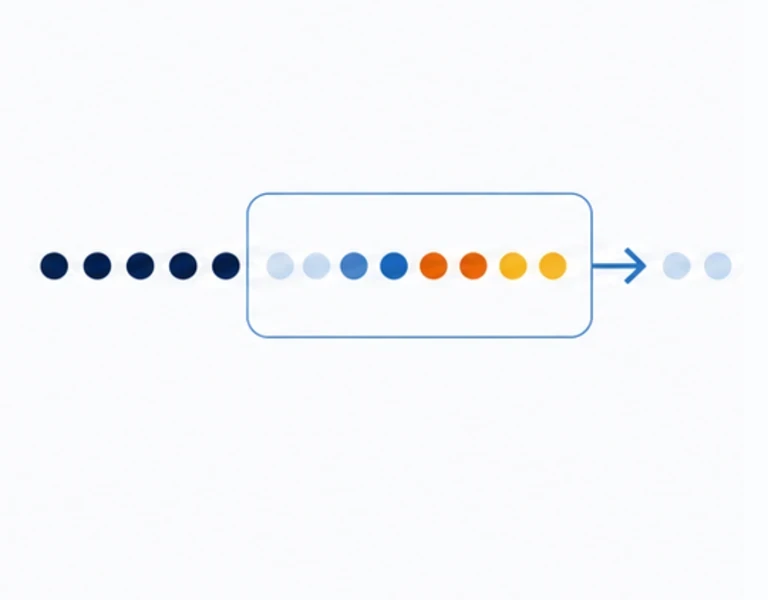
Continuous, not on-demand

Live alerts when quality metrics drift — before a customer escalates. You learn when it matters, not when you remember to check.
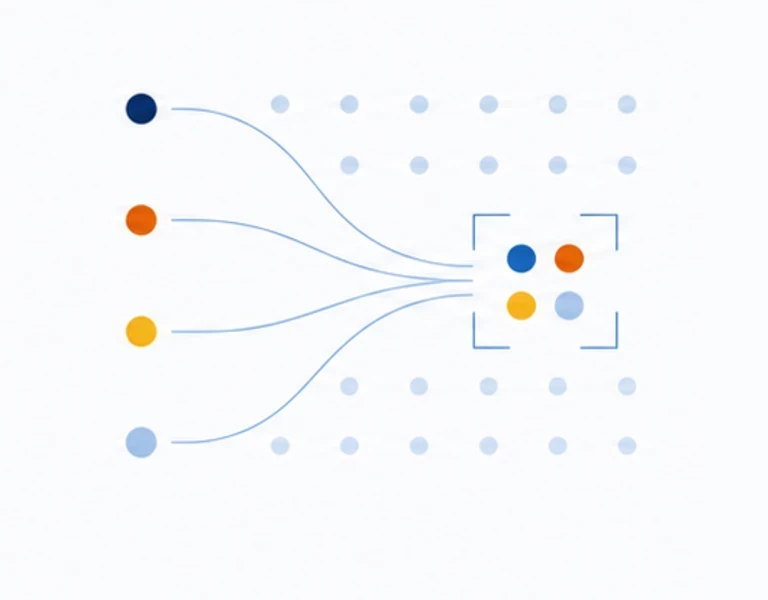
03

Joined to outcomes

Drop-off, thumbs-down, Slack replies, and support tickets — all tied to the runs and workflows that actually produced them.

04

Tracked through ship

Every finding moves from diagnosis to A/B replay to gated rollout to measured impact — with auto-rollback if real impact diverges from prediction.

A useful side effect

Quality work usually pays for itself — four to five figures a month per workflow.

Papaya's job is to make your agents actually work. As a side effect, the same diagnostic pass surfaces meaningful cost and latency wins — without trading off quality.

Typical first-month savings per workflow$4k–$48kAcross customers running 50k+ runs / mo per workflow.
Median time to first concrete improvement< 60 minFrom SDK install to a ranked, evidence-backed opportunity.
Quality risk on shipped findings0% regressionsA/B-tested and impact-gated before ever reaching 100% traffic.

Trust & control

Your prompts and your customers' data are yours.

You stay in control

Findings are surfaced for review — your team decides what ships and when. Human-in-the-loop by default, with optional automation as you grow comfortable.

Capture what you choose

Full payload, redacted, or metadata-only — set it per workspace. PII redaction runs before egress.

Audit every access

Region pinning, retention controls, right-to-delete, RBAC, SSO and SCIM on every enterprise plan.

Compliance-ready

SOC 2 Type II · GDPR · HIPAA-ready · ISO 27001 · CCPA · AES-256 in transit and at rest.

SOC 2 Type IIGDPRHIPAA-readyISO 27001CCPAAES-256

Get started

Wrap one agent. See your first finding before lunch.

Most teams have a ranked, evidence-backed opportunity in front of them inside the first hour — on their own runs. Try it on a sample workflow or wire it into your own.

Wrap your first agentExplore the sample dataset

No credit card. SDK works locally before any data leaves your infra.